


How Long Does an Electric Truck Battery Last? When Should It Be Replaced?
The battery is one of the most valuable components of an electric truck, making electric truck battery lifespan a key concern for transport businesses before investing. How many years can a battery last, when does degradation begin, and when should it be replaced? In practice, battery durability depends on several factors. Understanding these factors helps businesses accurately assess operating costs, plan maintenance, and optimize the return on investment in electric trucks.
How Long Does an Electric Truck Battery Last?
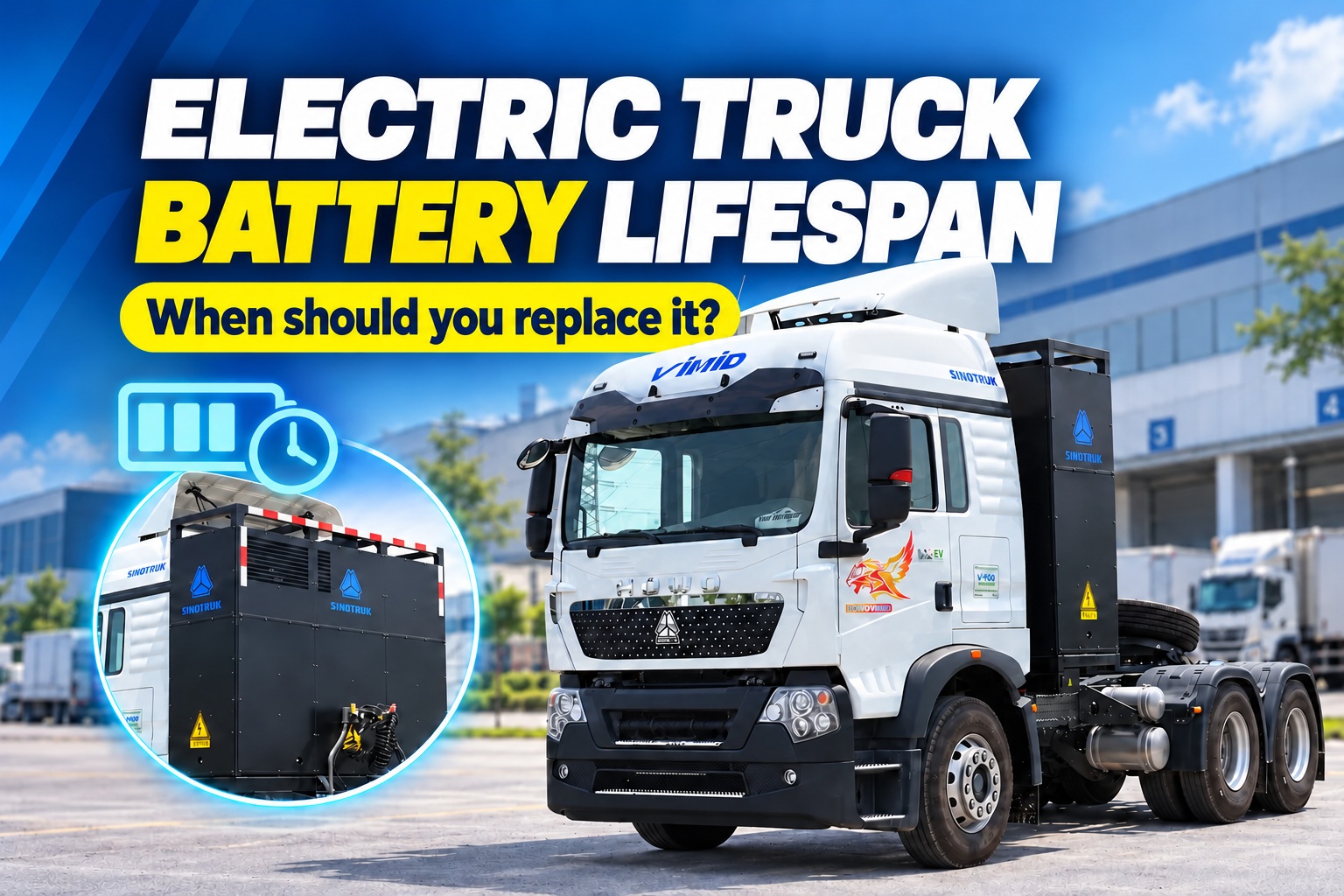
Electric truck batteries do not have a fixed lifespan that applies to every model. Depending on the technology and design, some commercial vehicle battery packs have a design life of more than 10 years. However, their actual service life also depends on charging cycles, temperature, and operating intensity. For example, CATL has stated that its Tectrans battery series for heavy-duty commercial vehicles has a design life of up to 15 years or 3 million kilometers.
Battery Lifespan in Years and Charging Cycles
Electric truck battery lifespan is generally assessed using two main criteria:
Calendar life: The period during which a battery can maintain sufficient performance to meet operational requirements, measured from the time it is first put into service.
Cycle life: The number of equivalent full charge-discharge cycles a battery can complete before its capacity declines to a specified threshold.
One equivalent full charge cycle does not necessarily mean plugging the vehicle in once. For example, using 50% of the battery capacity and recharging it, then repeating the process, may equal approximately one full charge cycle.
Suppose a battery pack is rated for 3,000 cycles before reaching a specified capacity threshold. If the truck uses the equivalent of one full battery cycle per day and operates 300 days per year, it would theoretically accumulate 3,000 cycles in approximately 10 years. This calculation is illustrative only, as battery degradation is also affected by aging, temperature, and other operating conditions.
How Do LFP and NMC Batteries Compare in Terms of Lifespan?
Two lithium-ion battery technologies commonly discussed in the electric vehicle market are LFP (Lithium Iron Phosphate) and NMC (Nickel Manganese Cobalt).
| Criteria | LFP Batteries | NMC Batteries |
| Cycle life | Generally have an advantage | Depends on design and operating conditions |
| Energy density | Generally lower | Generally higher |
| Thermal stability | Generally better | Require careful thermal management |
| Key advantage | Cycle durability and stability | Higher energy storage capacity per unit of mass |
Factors Affecting Electric Truck Battery Lifespan
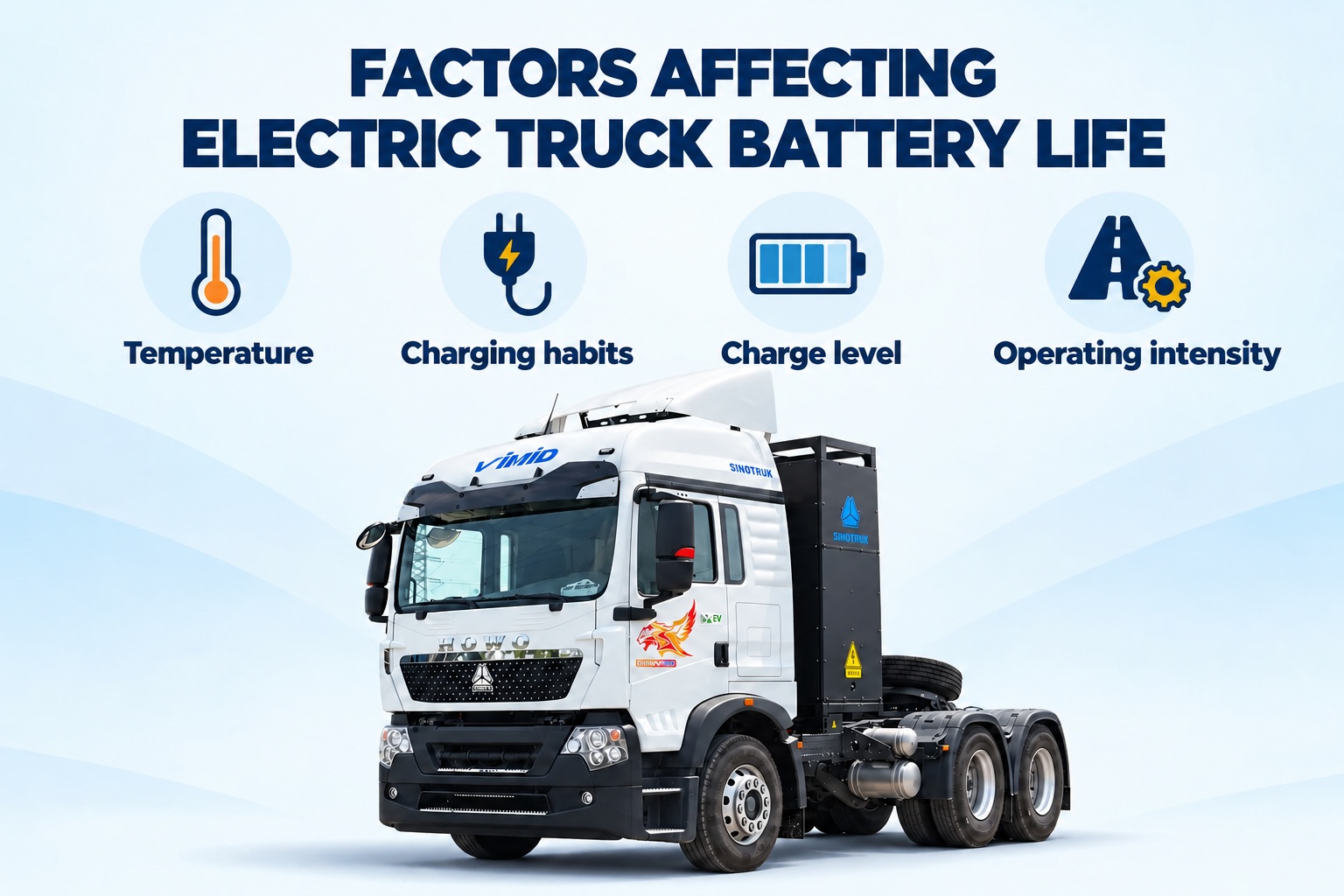
Even batteries of the same type can have significantly different service lives across vehicles. The main reasons include charging habits, ambient temperature, payload, and operating intensity.
Charging Frequency and Battery State of Charge
Lithium-ion batteries can age faster if they are frequently kept at nearly full or nearly depleted charge levels for extended periods. In particular, leaving a vehicle unused for several days with the battery at 100% charge may not be beneficial for long-term durability.
To minimize this effect, users should:
Maintain the battery within the state-of-charge (SOC) range recommended by the manufacturer.
Avoid frequently depleting the battery or leaving it at a very low charge level for extended periods.
Charge to 100% only when required for a journey or when recommended by the manufacturer for battery balancing.
For electric trucks operating continuously, businesses need to balance battery preservation with the need to maintain sufficient driving range. An unnecessarily low charging limit should not be imposed if it disrupts transport operations.
Does Fast Charging Reduce Electric Truck Battery Lifespan?
DC fast charging can accelerate battery capacity degradation when used frequently at high power levels, particularly if battery temperature is not properly controlled. However, this does not mean that fast charging will inevitably cause premature battery failure.
According to a Geotab study published in January 2026, based on more than 22,700 electric vehicles, average battery degradation was approximately 2.3% per year. Vehicles that frequently used high-power DC fast charging recorded degradation of around 3.0% per year, while those primarily using lower charging power experienced degradation of approximately 1.5% per year.
For transport businesses, the most suitable approach is to use charging power that matches the operating schedule. For example, trucks with long overnight downtime can prioritize moderate-power charging, while vehicles operating multiple shifts may require fast charging to reduce waiting time.
Ambient Temperature and Operating Conditions in Vietnam
High temperatures are one of the factors that affect electric truck battery lifespan. When batteries operate frequently in hot environments, the chemical reactions responsible for aging can accelerate.
In Vietnam, electric trucks may operate in high outdoor temperatures, particularly at seaports, industrial parks, construction sites, or along transport routes in the central and southern regions. Therefore, the thermal management system plays an important role in maintaining battery durability. It helps regulate temperature during charging, discharging, and operation, reducing the risk of overheating. Users should inspect and maintain the cooling system according to the manufacturer’s instructions and promptly address any abnormal battery temperature warnings.
Payload and Operating Intensity
Electric trucks that frequently carry heavy loads, climb steep gradients, or travel at high speeds consume more energy than vehicles operating under lighter-load conditions. Higher energy consumption may require more frequent charging, causing the battery to accumulate charge cycles more quickly. However, it is important to distinguish between the two: high energy consumption does not mean the battery immediately degrades.
For example, an electric tractor unit transporting containers at a port may operate multiple shifts per day. If it is charged correctly, its temperature is well managed, and regular maintenance is performed, the battery pack can still maintain effective performance over an extended period.
How Do Electric Truck Batteries Degrade? Signs to Look For
Electric truck battery degradation refers to the gradual loss of energy storage capacity over time. This is a natural aging process in lithium-ion batteries, and its rate depends on operating conditions.
What Is Battery State of Health (SOH)?
SOH (State of Health) is an indicator of a battery’s condition compared with when it was new. It is typically expressed as a percentage.
For example, an electric truck initially equipped with a battery pack offering 400 kWh of usable capacity would have an estimated usable capacity of 320 kWh when its SOH drops to 80%. The battery pack may still operate normally, but its energy storage capacity has decreased compared with its original condition.
Signs of Electric Truck Battery Degradation
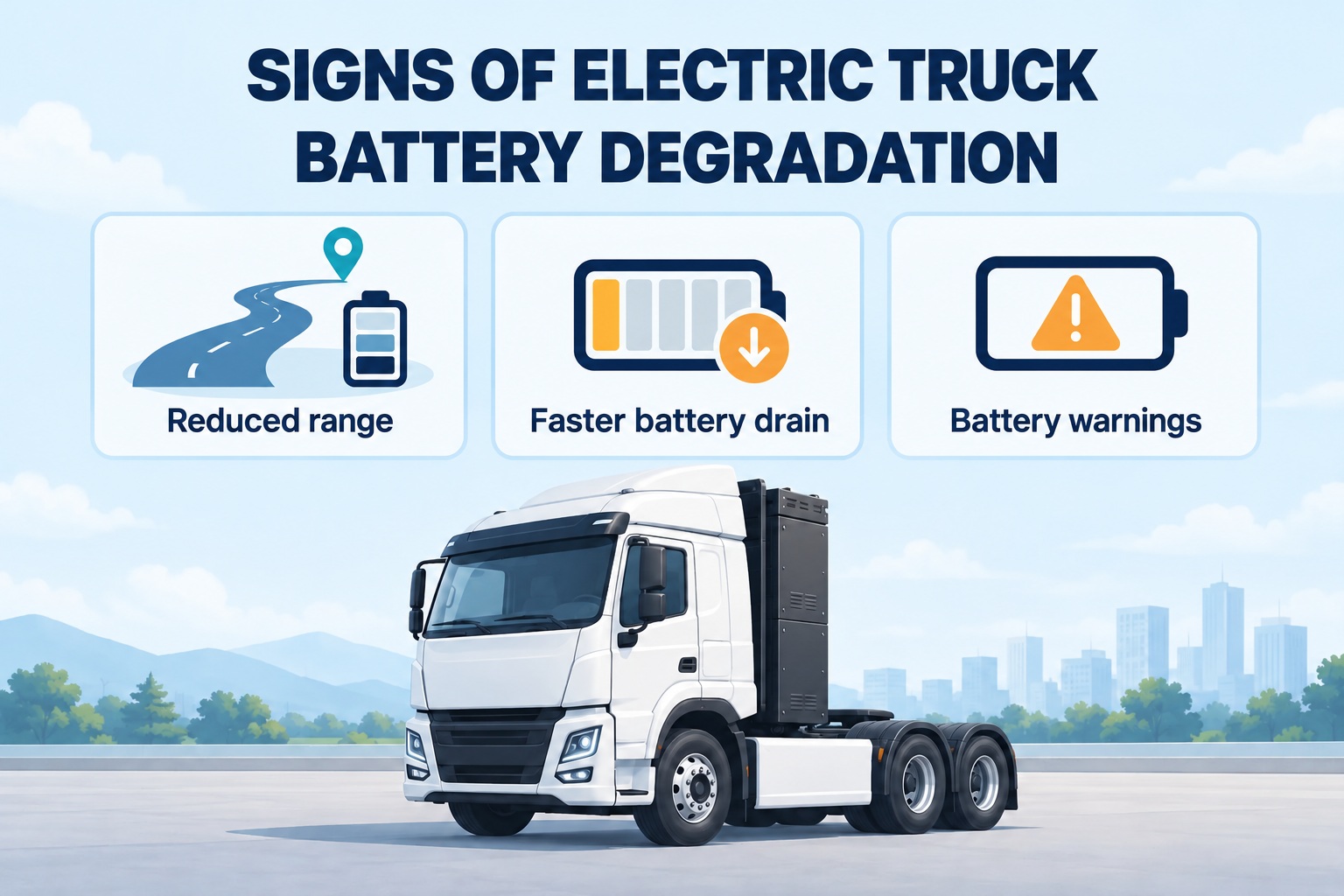
The following signs may indicate that an electric truck battery is losing capacity or experiencing a technical issue:
Reduced driving range: The truck travels fewer kilometers per charge under comparable payload, route, and driving conditions.
Reduced usable battery capacity: Diagnostic equipment indicates that the SOH is lower than previous readings.
Limited charging or discharging performance: The truck charges unusually slowly or experiences restricted operating power despite normal temperature conditions.
Battery warning alerts: The battery management system (BMS) detects faults related to voltage, temperature, or battery pack operation.
However, battery degradation should not be diagnosed based on a single symptom alone. Businesses should use specialized diagnostic equipment to identify the exact cause.
Can a Reduced Driving Range Be Caused by Battery Degradation?
A reduced driving range does not always indicate battery degradation. For example, an electric truck that previously carried light loads but now regularly transports heavy cargo will consume more energy. Similarly, driving on steep roads, using air conditioning continuously, or maintaining improper tire pressure can also reduce driving range.
Therefore, when a truck covers fewer kilometers per charge, businesses should compare average energy consumption, payload, route conditions, and the battery’s SOH before deciding whether repairs or battery replacement are necessary.
When Should an Electric Truck Battery Be Replaced?
An electric truck battery should only be replaced when it no longer meets operational requirements, has a fault that cannot be suitably repaired, or presents a safety issue confirmed by qualified technicians. There is no universal number of years or kilometers after which every electric truck battery must be replaced.
Does a Battery at 80% Capacity Need Immediate Replacement?
Not necessarily. An SOH of 80% is often used as a reference threshold when assessing battery lifespan or warranty conditions for certain products. However, this does not mean the battery must be replaced as soon as it reaches this level.
For example, a new electric truck may have a driving range of 250 km under specific operating conditions. If its battery capacity drops to 80%, its theoretical driving range may decrease to approximately 200 km, assuming all other factors remain unchanged.
If a business uses the truck to transport goods along a fixed route of 100–150 km per day, the battery may still meet its needs. Conversely, if the truck regularly travels 190–200 km without access to charging facilities along the route, the remaining capacity may not provide sufficient operational reserve. Therefore, battery replacement should be determined by actual operating requirements rather than the SOH figure alone.
When Should a Battery Be Inspected or Replaced?
Businesses should take their vehicles to a qualified service provider for battery assessment if they experience any of the following issues:
A significant drop in SOH that leaves the driving range insufficient for transport requirements.
Recurring voltage, temperature, or cell imbalance faults.
Battery damage caused by collisions, flooding, or external impacts.
Abnormal charging or discharging limitations that cannot be resolved through routine maintenance.
Repair costs that are excessive compared with the battery pack’s remaining service value.
For faults involving high-voltage electrical safety, the vehicle must be inspected and repaired according to the manufacturer’s procedures. It should not continue operating when a safety warning is present.
Is Replacing an Electric Truck Battery Expensive?
Replacing an electric truck battery can be costly because the battery pack is one of the vehicle’s most valuable components. Heavy-duty electric trucks and electric tractor units, in particular, often use high-capacity battery packs to meet freight transport requirements.
Replacement costs depend on battery capacity, technology, pack design, and the manufacturer’s parts supply policy.
Battery capacity: A 400 kWh battery pack will generally cost more than a 100 kWh pack if other factors are comparable.
Battery technology: Costs depend on battery chemistry, design, thermal management systems, and technical specifications.
Replacement scope: Replacing individual modules, repairing components, or replacing the entire battery pack involves different costs.
Labor and technical requirements: Removing, installing, testing, and calibrating high-voltage electrical systems requires specialized equipment.
Warranty coverage: Certain battery faults may qualify for coverage if the warranty conditions are met.
Because battery and replacement part prices vary by vehicle model, businesses should request an official quotation rather than rely on a single price for all electric trucks.
How to Extend Electric Truck Battery Lifespan
Proper use and maintenance can help slow capacity degradation, extend battery service life, and reduce unexpected expenses.
Charge the Battery Correctly
Prioritize charging within the SOC range recommended by the manufacturer. Avoid frequently depleting the battery or leaving it at 100% charge for extended periods when unnecessary.
For electric trucks operating on fixed routes, businesses can develop charging schedules based on shift patterns to meet driving range requirements while minimizing unnecessary high-power charging sessions.
Manage Battery Temperature
The cooling and thermal management systems should be inspected regularly. If an abnormal battery temperature warning appears, address it promptly rather than continuing to operate the vehicle under heavy loads.
Operate Within the Designed Payload Limits
Do not exceed the permitted payload, avoid sudden acceleration, and maintain speeds appropriate for traffic conditions.
Consistent driving habits not only help reduce energy consumption but also minimize additional charging needs during operation.
Monitor Battery Condition Regularly
Businesses should monitor parameters such as SOH, energy consumption in kWh/km, battery temperature, and BMS alerts. For large electric truck fleets, recording monthly operating data helps identify vehicles with unusually rapid degradation and arrange inspections before transport schedules are affected.
Conclusion
Electric truck battery lifespan depends on battery technology, charging cycles, temperature, and operating practices. With appropriately designed battery packs and proper use, businesses can maintain effective vehicle operation for many years without necessarily needing early battery replacement. In particular, reduced battery capacity does not automatically mean the battery must be replaced if it still meets transport requirements.
When choosing an electric truck, businesses should carefully review battery specifications, warranty policies, and the vehicle’s ability to meet actual driving range requirements. These factors are essential for optimizing operating costs and improving long-term investment efficiency.
Featured news



Related news

What Driving License Do You Need to Drive a HOWO Truck?