

Electric Truck Battery Swapping: How It Works and Its Benefits
Battery swapping for electric trucks replaces a used battery pack with a pre-charged one, so the vehicle can quickly get back to hauling. Some systems complete the swap in about 3–5 minutes, offering a way to restore energy for fleets that run multiple shifts. However, the real-world benefit depends on vehicle design, the station’s service capacity and the cost of the service.
What Is Battery Swapping for Electric Trucks?
Battery swapping for electric trucks is a method of removing a low-charge battery pack from the vehicle and installing a compatible, pre-charged one. The removed pack goes into the station to be inspected, charged and prepared for its next use.
The key difference is that charging time is separated from vehicle stopping time. The truck can keep running on another pack while the one just removed is still charging.
This is a way of restoring energy during normal operation. It is different from replacing a battery because of damage or capacity loss. Nor is the pack received at a station necessarily new; its quality and usable capacity must meet the standards of the system and the service conditions.
A battery swapping system needs three components working together: a vehicle designed for swapping, a compatible battery pack, and a station that carries out the swap and handles charging and battery management. For example, CATL’s QIJI solution (CATL is the world’s largest EV battery manufacturer) combines battery blocks, swap stations and a data management platform.
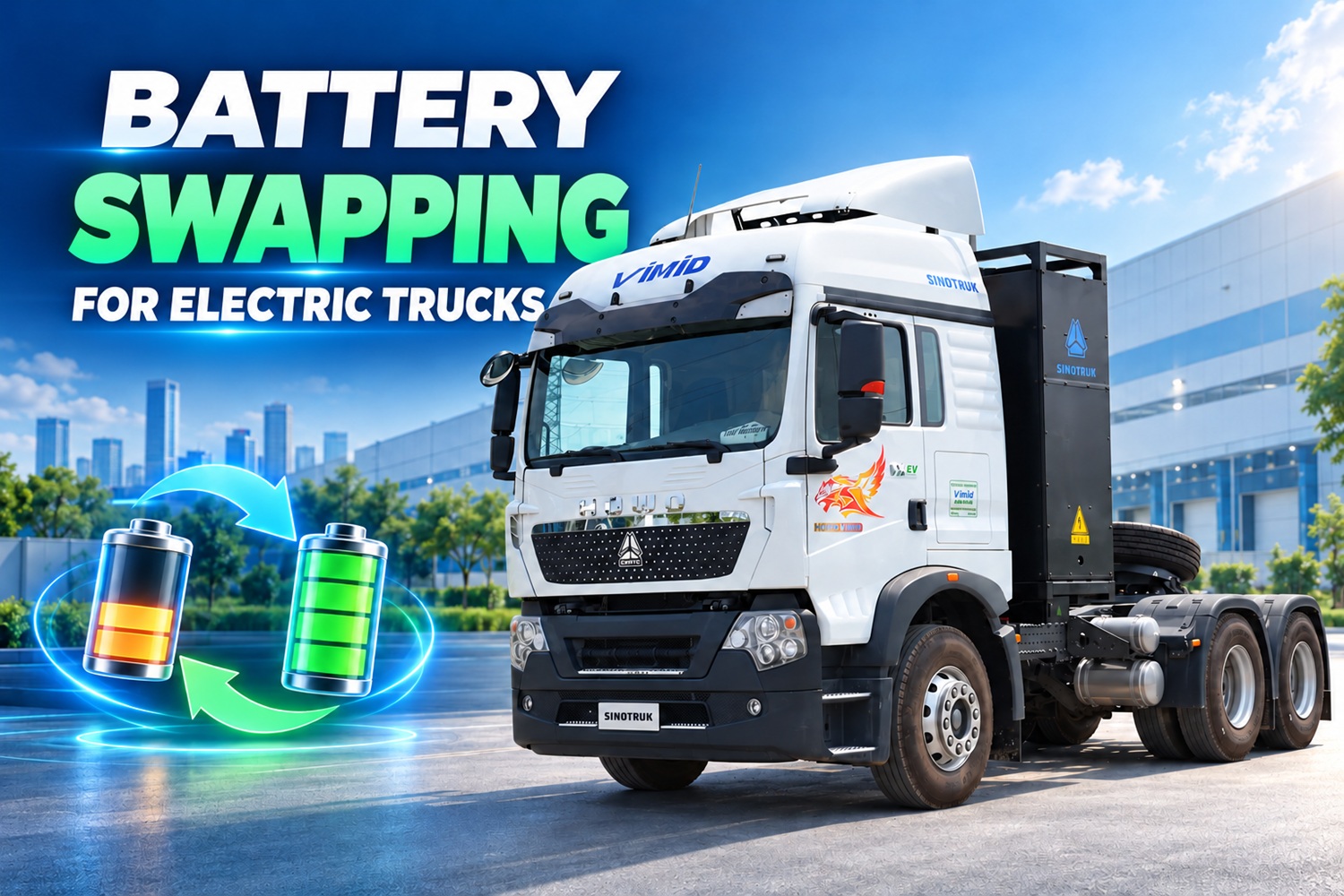
How Does the Battery Swapping Process Work?
Depending on the design, the battery can be removed and installed by a lifting mechanism or by equipment operating beneath the chassis. The exact sequence varies between systems, but it can be summarized in five steps:
| Step | What happens |
|---|---|
| Vehicle identification | Identify the vehicle, its battery configuration and its service entitlement |
| Positioning | Guide the vehicle into the station’s correct working position |
| Battery removal | Follow the safety procedure, unlock and remove the battery pack |
| Installing the charged pack | Place a compatible pack in position, lock it and connect it |
| Completion check | Confirm the system status before the vehicle leaves the station |
In SANY’s 2022 demonstration of its smart swap station, the driver scanned a QR code to trigger an automated sequence of unlocking, swapping and relocking. The process took under 5 minutes. This is the result of one specific system, not a default time for every electric truck.
For transport operators, automation reduces manual handling, but suitable operating and troubleshooting procedures are still needed. Drivers must follow each station’s instructions and must not interfere with locking mechanisms or high-voltage connections.
How Long Does It Take to Swap an Electric Truck Battery?
Some electric truck battery swapping solutions take about 3–5 minutes. However, the time to perform the swap should be distinguished from the total time a vehicle spends on one station visit. At China’s Yantian port, an underchassis swap station put into operation in 2024 by QIJI Energy and the port operator takes about 5 minutes per swap. It is a real-world example of use in port logistics.
When planning transport operations, a business needs to account for:
Total energy replenishment time = Travel time to the station + Queue wait + Positioning, swapping and checking + Return to route
If the station is far from the route or has run out of ready packs, the advantage of a quick swap can shrink considerably. When surveying options, it is better to record the time from when the truck leaves its route until it is back at work, rather than only watching a video of the swap itself. Note also that swapping does not fully charge a depleted pack in 5 minutes. That pack still needs charging time at the station; the truck simply receives a different pack that was prepared in advance.
Benefits of Battery Swapping for Electric Trucks
Less Downtime for Energy Replenishment
The most direct benefit is shorter waiting time at the energy point. This matters for trucks running multiple shifts, shuttling containers or operating continuous cycles.
However, the time saved only produces extra revenue if the business has enough cargo, drivers and loading windows to complete additional work. If the truck still waits for loading and unloading, a faster swap will not necessarily increase the number of trips.
Easier Fleet Organization on Fixed Routes
For fleets that regularly return to a port, factory or depot, a business can schedule swaps by shift. Energy needs and arrival times are also easier to forecast than for random, ad hoc routes. This gives the operator a basis for determining the number of swap bays, the reserve battery stock and the charging capacity required.
Separating Vehicle and Battery Costs
Some business models allow vehicle and battery ownership to be separated. A company buys or leases the vehicle, while the battery is supplied under a separate contract.
QIJI includes a vehicle-battery separation model in its swapping solution for heavy-duty trucks. However, how it is applied, the rental rate and responsibility for the battery must be defined for each market, supplier and contract.
Lower upfront investment does not necessarily mean lower total cost of use. Owners still need to account for battery rental and service fees over the whole operating period.
Limitations to Consider Before Investing in Swappable Electric Trucks
Vehicles and Stations Must Be Compatible
Not every electric truck can swap batteries. The vehicle needs a suitable design for battery location, removal and installation mechanism, electrical connection, battery management and communication with the station.
Two vehicles using CATL cells or having the same capacity is not enough to conclude they can share a station. Even when a system supports multiple brands, that capability is limited to configurations that have been designed and verified as compatible.
Stations Need Both Equipment and Reserve Batteries
Beyond land and power supply, a station needs a swapping mechanism, a charging system, management equipment, safety systems and packs on standby. The study Electrifying Heavy-Duty Trucks: Battery-Swapping vs Fast Charging indicates that battery swapping can reduce stopping time and improve transport efficiency, but may require more batteries across the whole system. This must be factored into the investment case.
A station with few vehicles will struggle to spread its investment cost. Conversely, if too many vehicles arrive and there are not enough charged packs, queues will still form.
Quality of the Pack Received Must Be Clearly Defined
Businesses need to clarify the energy level delivered, the battery’s state of health, inspection standards and what happens when a pack does not meet requirements. Important contract terms include liability for battery damage, support procedures if the vehicle develops a fault after a swap, and what happens if the station temporarily stops service. These points directly affect the ability to deliver on schedule.
Battery Swapping vs Fast Charging for Electric Trucks
| Criteria | Battery swapping | Fast charging |
|---|---|---|
| How energy is restored | Replace with a pre-charged pack | Charge the pack that stays on the vehicle |
| Vehicle requirements | Swap-ready design, compatible with the station | Compatible with the charging system |
| Stopping time | Depends on the swap operation, queue and pack availability | Depends on the energy needed, actual power received and battery conditions |
| Infrastructure | Swapping equipment, charging system and reserve packs | Chargers, power supply and parking position |
| Battery management | Packs can rotate between vehicles and stations | Pack generally stays with the vehicle |
| Situations worth considering | Multi-shift fleets on stable routes that need less downtime | Vehicles with parking time suited to charging at the depot or at pickup/delivery points |
Battery swapping is not automatically better than fast charging in every situation. If vehicles are parked for many hours overnight and can recharge enough for the next day, a business should consider whether investing in a swapping system adds proportionate value. Conversely, if charging stops are limiting the number of trips, swapping is worth including in the comparison. A sound way to evaluate is to put both options on the same route, with the same cargo load and the same operating requirements.
How Is the Cost of Electric Truck Battery Swapping Calculated?
You should not quote a single general price for battery swapping without a specific price list and service terms. Depending on the contract, costs may include energy charges, swap fees, battery rental or a subscription.
When comparing with direct charging, businesses should use:
Energy and service cost per km = Total electricity, battery rental and related service costs in the period ÷ Total km actually driven
Check which items are already included in the package to avoid double counting. If you invest in your own station, add the costs of equipment, reserve batteries, land, maintenance and operation.
The value of reduced downtime should also be calculated separately. Count the benefit of extra trips only when they can actually be performed and generate revenue that covers the additional costs; do not convert all the time saved into profit.
Which Businesses Should Consider Swappable Electric Trucks?
Based on operating characteristics, the cases worth investigating include:
- Port logistics and container shuttling: Vehicles operate around fixed gathering points, so a centralized service station can be organized.
- Factory-to-warehouse transport: Stable routes make swap demand easier to forecast.
- Dump trucks or construction vehicles working within a concentrated area: Shared infrastructure for a compatible fleet can be considered.
- Long-haul transport: Requires a suitable chain of stations along the whole journey, plus a backup plan.
This is a guide for selection based on needs. It is not a claim that every fleet in the groups above will benefit from battery swapping.
Frequently Asked Questions About Electric Truck Battery Swapping
Can a swappable truck also be charged directly?
Some models support both methods. SANY has introduced versions of heavy-duty trucks, dump trucks and concrete mixers whose batteries can be both charged and swapped. However, check the configuration of the specific vehicle before buying.
Does battery swapping let a truck travel farther?
Swapping lets the truck continue its journey on energy from another pack. The distance between two swaps still depends on usable capacity, payload, terrain and operating conditions.
Can batteries be swapped between two trucks of different brands?
Yes, within systems that support compatible configurations. The Yantian port station is one example that serves multiple electric truck models and brands; that does not mean every electric vehicle can use this station.
Choosing Battery Swapping Based on Your Operating Needs
Battery swapping for electric trucks directly addresses the problem of downtime for energy replenishment. Its real value depends on how well the vehicle, battery, station and transport schedule are aligned. When researching electric trucks, give your advisor the distance per shift, payload, number of trips and acceptable downtime. For electric truck inquiries, please contact U-Truck at Hotline 0816808899.